
How to Get CE Certification: Step-by-Step Guide to CE Marking and CE Certificates
Learning how to get a CE certificate starts with one question: which EU legislation applies to your product? From there, you apply the relevant harmonised standards, complete the required conformity assessment procedure, compile the technical file, sign the EU Declaration of Conformity and affix the CE marking. Where the legislation requires it, the conformity assessment is carried out by a notified body; where it does not, the manufacturer may still choose voluntary certification by an independent third-party body. See our CE certification and CE testing services by Notified Body NB 2908.
“CE certificate” is the general term for the documents showing that a product meets the essential health and safety requirements of EU technical legislation: the EU Declaration of Conformity drawn up by the manufacturer and, where applicable, a certificate issued by a notified body or, in the voluntary field, by an independent third-party certification body. This guide explains each step, when a notified body is required, when voluntary third-party certification is worth considering and which documents you need.
- NB 2908 – EU Notified Body
- TÜRKAK AB-0155-U – ISO/IEC 17065
- 19 Years of Experience
- Machinery · Noise · EMC
How to get CE certification in 6 steps

- Scope: Identify all legislation that applies to the product.
- Standards: Identify the harmonised standards (EN) to be applied.
- Procedure: Select the conformity assessment procedure laid down in the legislation and establish whether a notified body is required. If it is not, you can still opt for voluntary certification by an independent third-party body.
- Testing and assessment: Have the product undergo the required tests, inspections and assessments; submit your application to a notified body where one is required, or to an independent third-party certification body for voluntary certification.
- Technical file and declaration: Complete the technical file, then draw up and sign the EU Declaration of Conformity.
- Marking: Affix the CE marking (and, where required, the notified body number) to the product.
What does the CE marking mean?

The CE marking is not a quality mark. It shows that the manufacturer declares, under its sole responsibility, that the product complies with all EU legislation that applies to it. Where a product falls under more than one piece of legislation (for example, machinery safety and EMC for a machine), the CE marking indicates conformity with all of them. CE-marked products remain subject to market surveillance; non-compliant products may be banned from the market and recalled.
Which products require the CE marking?
The CE marking may only be affixed to products covered by EU harmonisation legislation that provides for it. Affixing it to a product outside that scope is misleading and unlawful. The main product groups are:
- Machinery – Machinery Directive 2006/42/EC
- Equipment for use outdoors – Outdoor Noise Directive 2000/14/EC
- Electrical and electronic equipment – EMC Directive 2014/30/EU
- Low-voltage equipment, pressure equipment, ATEX equipment, radio equipment, gas appliances, toys, medical devices and others
To identify the harmonised standards that apply to your product, you can use our Harmonised Standards Finder.
Legal basis
- EU: Regulation (EC) No 765/2008 and Decision No 768/2008/EC (New Legislative Framework), Regulation (EU) 2019/1020 on market surveillance, and the product-specific directives and regulations.
Not sure which of these apply to your product? See our guide Which regulations apply to CE certification?, which lists the 2026 CE marking directives and regulations and the typical combinations for machinery.
When is a notified body required?
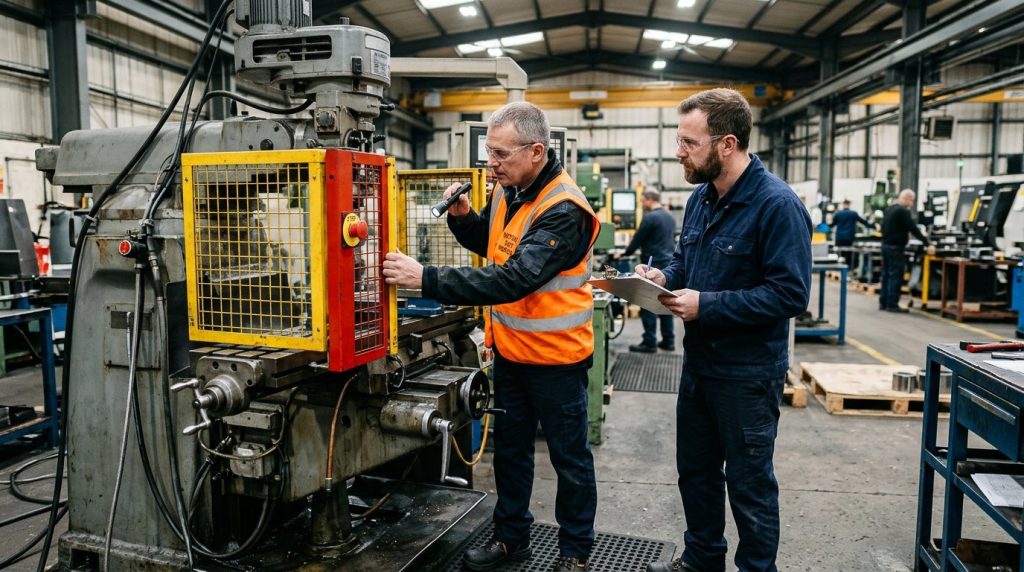
For lower-risk products, the manufacturer can declare conformity on the basis of its own internal production control. For higher-risk products, assessment by an independent notified body is mandatory. For the three directives within TESTPLUS’s notification scope:
| Directive | No notified body required | Notified body required |
|---|---|---|
| 2006/42/EC Machinery | Machinery not listed in Annex IV – Annex VIII internal production control | Annex IV machinery – Annex IX EC type-examination or Annex X full quality assurance |
| 2000/14/EC Outdoor Noise | Article 13 equipment (noise marking only) – Annex V internal production control | Article 12 equipment (subject to noise limits) – Annex VI, Annex VII or Annex VIII |
| 2014/30/EU Electromagnetic Compatibility | Module A – internal production control | At the manufacturer’s choice: Module B + C – EU-type examination |
Voluntary certification by an independent third-party body
For products where notified body assessment is not mandatory (for example, machinery not listed in Annex IV of 2006/42/EC, Article 13 equipment under 2000/14/EC and equipment under Module A of 2014/30/EU), the manufacturer declares conformity under its own responsibility. For these products, the manufacturer may obtain voluntary third-party certification to have conformity verified by an independent body.
The main benefits of certification by an independent body are:
- Conformity with the essential health and safety requirements verified through testing and examination by an impartial body
- Conformity supported by an independent certificate during market surveillance and import inspections
- Meeting the need for independent certification required by leasing and finance companies, tenders and buyers
- Greater credibility with customers in domestic and export markets
Important: A voluntary certificate is not an EC type-examination certificate and does not replace the manufacturer’s legal obligations. The EU Declaration of Conformity is still drawn up by the manufacturer, and under voluntary certification no notified body number is added next to the CE marking.
In addition to mandatory conformity assessment for machinery safety, noise and EMC, TESTPLUS also provides voluntary certification; for example, it issues machinery safety certificates for generators and compressors not listed in Annex IV.
Conformity assessment modules
Decision No 768/2008/EC defines the standard modules from which legislation can choose. Which module applies is determined by the legislation covering the product.
| Module | Name | Phase | Role of the notified body |
|---|---|---|---|
| A | A – Internal production control | Design + Production | None – the manufacturer declares conformity |
| A1 | Internal production control plus supervised product testing | Design + Production | Carries out or supervises specific product tests |
| A2 | Internal production control plus supervised product checks at random intervals | Design + Production | Carries out product checks at random intervals |
| B | EU-type examination | Design | Examines the technical design / type specimen and issues an EU-type examination certificate |
| C | Conformity to type based on internal production control | Production (with B) | None – production phase |
| C1 | Conformity to type based on internal production control plus supervised product testing | Production (with B) | Carries out or supervises specific product tests |
| C2 | Conformity to type based on internal production control plus supervised product checks at random intervals | Production (with B) | Carries out product checks at random intervals |
| D | Conformity to type based on quality assurance of the production process | Production (with B) | Approves and monitors the production quality system |
| D1 | Quality assurance of the production process | Design + Production | Approves and monitors the production quality system |
| E | Conformity to type based on product quality assurance | Production (with B) | Approves and monitors the final inspection and testing quality system |
| E1 | Quality assurance of final product inspection and testing | Design + Production | Approves and monitors the final inspection and testing quality system |
| F | Conformity to type based on product verification | Production (with B) | Examines and tests every product or a statistical sample |
| F1 | Conformity based on product verification | Design + Production | Examines and tests every product or a statistical sample |
| G | Conformity based on unit verification | Design + Production | Assesses and certifies each individual product |
| H | Conformity based on full quality assurance | Design + Production | Approves and monitors the design, production and testing quality system |
| H1 | Conformity based on full quality assurance plus design examination | Design + Production | In addition to the quality system, examines the design and issues an EU design-examination certificate |
Source: Decision No 768/2008/EC, Annex II. Module B is never used on its own; for the production phase it is combined with C, C1, C2, D, E or F.
Technical file

The technical file is the set of documents demonstrating that the product meets the requirements of the legislation, and preparing it is the manufacturer’s responsibility. It generally includes:
- A general description of the product and its intended use
- Design and manufacturing drawings, circuit diagrams
- Risk assessment
- A list of the harmonised standards applied and a description of the solutions adopted where standards were not applied
- Calculations, test and inspection reports
- Instructions for use
- The notified body certificate, where applicable
- A copy of the EU Declaration of Conformity
Unless otherwise specified, the technical file must be kept for 10 years after the product is placed on the market (in series production, after the last unit is manufactured) and made available to the competent authorities on request.
EU Declaration of Conformity
The declaration, signed by the manufacturer or its authorised representative, generally contains:
- Product model, type and serial/batch number
- Name and address of the manufacturer (and of the authorised representative, where applicable)
- A statement that the declaration is issued under the sole responsibility of the manufacturer
- All EU legislation the product complies with
- The harmonised standards or other technical specifications applied
- Name and number of the notified body and the certificate number, where applicable
- Place and date of issue, name, position and signature of the signatory
Product-specific legislation may require additional information; for example, 2000/14/EC requires the measured and guaranteed sound power levels to be stated in the declaration.
Affixing the CE marking
- The CE marking is affixed by the manufacturer or its authorised representative before the product is placed on the market.
- Unless the legislation specifies otherwise, it must be at least 5 mm high and keep the proportions of the official template.
- It is affixed visibly, legibly and indelibly to the product or its data plate; where this is not possible, to the packaging and accompanying documents.
- Where a notified body is involved in the production control phase, its four-digit number is added next to the CE marking (e.g. CE 2908).
- No other markings that could mislead as to the meaning or form of the CE marking may be used.
- Equipment under 2000/14/EC must also bear the guaranteed sound power level (LWA) label together with the CE marking.
Important: Machinery Regulation (EU) 2023/1230
The Machinery Regulation (EU) 2023/1230, which replaces the Machinery Directive 2006/42/EC, applies in the EU from 20 January 2027. It introduces new rules on the list of high-risk machinery, safety components, systems with artificial intelligence and digital instructions for use. Machinery placed on the market after this date must be assessed under the new Regulation.
In which countries is the CE marking valid?
- European Economic Area: the 27 EU Member States plus Iceland, Liechtenstein and Norway.
- Northern Ireland: the CE marking continues to apply under the Windsor Framework.
- Great Britain (England, Wales, Scotland): the national marking is UKCA; however, the CE marking continues to be accepted for many product groups, including machinery and EMC.
Market surveillance and sanctions

Products bearing the CE marking are subject to market surveillance and inspection. In the EU, the market surveillance authorities of the Member States carry out these checks under Regulation (EU) 2019/1020, including checks on imported products.
During an inspection, in addition to the CE marking, the EU Declaration of Conformity, the technical file, test reports and, where required, the notified body certificate are requested. If non-compliance is found, the manufacturer is required to correct it; otherwise, the product may be banned from the market, recalled and administrative fines may be imposed.
What determines the cost of getting a CE certificate?
There is no fixed price for CE certification. The main factors that determine the cost are:
- The legislation covering the product and the conformity assessment procedure to be applied (e.g. 2006/42/EC Annex IX EC type-examination, 2000/14/EC Annex VI or Annex VIII)
- The complexity of the product and the number of models and variants
- The scope of the required tests and measurements (electrical safety, EMC, noise measurement, etc.)
- Whether testing is carried out in a laboratory or at the manufacturer’s premises
- The completeness of the technical file; gaps lead to additional review rounds
A firm quotation is provided after the product information and technical documents have been reviewed. For our pricing principles, see our duration and fee principles page.
Related content
- CE marking requirements: a checklist for US manufacturers
- Machinery CE certification: Machinery Directive 2006/42/EC
- Machinery safety tests: which tests are carried out?
- Noise certification under the Outdoor Noise Directive 2000/14/EC
- EMC certification under Directive 2014/30/EU
- Machinery certification process
- Harmonised Standards Finder
- Which regulations apply to CE certification?
Why TESTPLUS?
- EU Notified Body NB 2908: notified under 2006/42/EC, 2000/14/EC and 2014/30/EU.
- Machinery, noise and EMC: one of only seven bodies worldwide accredited and notified under all three of the Machinery (2006/42/EC), Outdoor Noise (2000/14/EC) and EMC (2014/30/EU) directives.
- Voluntary third-party certification: independent certification for products where a notified body is not mandatory.
- TÜRKAK accreditation: AB-0155-U (ISO/IEC 17065) and AB-0181-YS (ISO/IEC 17021-1).
- 19 years of experience and impartial, independent conformity assessment.
Get a quotation for your CE certificate
Frequently asked questions
How do I get a CE certificate for my product?
Identify the EU legislation and harmonised standards that apply to your product, carry out the required conformity assessment procedure (with a notified body where the legislation requires one), compile the technical file, sign the EU Declaration of Conformity and affix the CE marking. For machinery, outdoor equipment and EMC, TESTPLUS (NB 2908) carries out the notified body assessment and, where a notified body is not mandatory, voluntary certification as an independent third-party body.
Is a CE certificate mandatory?
If the product falls within the scope of EU legislation that provides for CE marking, the CE marking is mandatory for placing it on the market in the EU. The CE marking may not be affixed to products outside that scope.
Who issues the CE certificate?
The manufacturer draws up the EU Declaration of Conformity. Where the legislation requires it, a notified body published by the European Commission in the NANDO database (e.g. NB 2908) carries out the assessment and issues a certificate.
Does a CE certificate have a validity period?
The declaration of conformity has no fixed term; it remains valid as long as the product, the legislation or the applied standards do not change. EC type-examination certificates under Annex IX of 2006/42/EC, however, are reviewed every 5 years.
How long does it take to get a CE certificate?
The duration depends on the legislation covering the product, the applicable procedure, the scope of testing and how complete the technical file is.
Are the CE marking and the CE certificate the same thing?
No. The CE marking is the logo on the product. The CE certificate refers to the documents behind that marking: the declaration of conformity, the technical file and, where applicable, the notified body certificate.
How can I check whether a notified body is genuine?
You can check the body’s number and the legislation for which it is notified in the European Commission’s NANDO database. Certificates issued by TESTPLUS can be verified on our certificate verification page.
Is the CE marking the same as a voluntary certification mark?
No. The CE marking is a legal requirement for products within its scope. Voluntary marks are not required for placing a product on the market and do not replace the CE marking.
Does the CE marking alone show that a product is safe?
No. The CE marking is the manufacturer’s declaration. Conformity is based on the technical file, test reports, the EU Declaration of Conformity and, where required, a notified body certificate; these documents are requested during market surveillance.
How much does CE certification cost?
There is no fixed price for CE certification. The cost depends on the applicable EU legislation, the conformity assessment procedure (for example EC type-examination, unit verification or voluntary third-party certification), the number of models in the product family, the tests required and whether a factory visit is needed. TESTPLUS issues a written quotation after reviewing the application and the product information.
Do US manufacturers need CE certification to sell in the EU?
Yes, if the product falls within the scope of EU legislation that provides for CE marking. The rules are the same for US and EU manufacturers: the manufacturer is responsible for the conformity assessment, the technical file and the EU Declaration of Conformity, and a notified body must be involved where the legislation requires it. Products placed on the EU market also need an economic operator established in the EU (importer, authorised representative or fulfilment service provider) under Regulation (EU) 2019/1020. TESTPLUS (NB 2908) handles machinery, outdoor noise and EMC certification for US manufacturers through its USA contact office.
