
CE Testing of Machinery
Machinery Safety Tests, Standards and On-Site Testing
Machinery safety tests are the inspections, measurements and functional verifications that demonstrate a machine meets the essential health and safety requirements of Annex I of the Machinery Directive 2006/42/EC. The results form the technical basis of the CE marking, the EC declaration of conformity and, for Annex IV machinery, the EC type-examination certificate. For conformity assessment routes, see our CE certification for machinery page.
On this page: Why test Type A, B, C standards General tests Type C standards Annex IV machinery On-site testing Process Regulation 2023/1230 FAQ
Why Is a Machinery Safety Test Required?
Before placing a machine on the EU market, the manufacturer must carry out a risk assessment, apply the relevant essential health and safety requirements and keep the evidence in the technical file. A machinery safety test provides that evidence in a measurable and repeatable form:
- It verifies that the protective measures identified in the risk assessment actually work on the finished machine.
- It demonstrates compliance with harmonised standards, which gives presumption of conformity with the Directive.
- It supplies the test reports required in the technical file and in the EC type-examination of Annex IV machinery.
- It reduces the risk of accidents, market surveillance findings, recalls and customs delays.
Why choose voluntary third-party certification?
For machinery outside Annex IV, the manufacturer declares conformity on its own, so it is the only party standing behind the product. TESTPLUS also serves this area on a voluntary basis as an independent third-party body:
Impartial evidence
The risk assessment, technical file and safety tests are verified against the harmonised standards by a body with no interest in the result.
Early detection
Nonconformities are identified before the machine reaches the market, when they are least costly to correct.
Commercial confidence
Buyers, importers and tender authorities receive documentation from an independent body.
Readiness
The manufacturer is better prepared for market surveillance and import inspections.
Voluntary certificates are issued outside our notified body scope and do not replace the manufacturer’s declaration of conformity.
The Standards Framework: Type A, Type B and Type C Standards
Harmonised machinery safety standards are organised in three levels. The test programme for a machine is built from all three.
| Level | Content | Examples |
|---|---|---|
| Type A | Basic concepts and design principles for all machinery | EN ISO 12100 (risk assessment and risk reduction) |
| Type B | One safety aspect (B1) or one type of safeguard (B2) across a wide range of machinery | EN 60204-1, EN ISO 13849-1, EN ISO 13857, EN ISO 14120 |
| Type C | Detailed safety requirements and verification methods for a particular machine or group of machines; where a type C standard exists, it takes precedence for the aspects it covers | EN 280-1, EN ISO 16092, EN ISO 19085, EN 12622 |
Generally Applied Machinery Safety Tests
The tests below are applied to most machines, regardless of the product group. The exact scope is defined by the risk assessment and by the applicable type C standard.
Risk assessment verification (EN ISO 12100)
The intended use, limits of the machine, hazard identification, risk estimation and the selected risk reduction measures are reviewed against the machine itself. Each significant hazard must be traceable to a protective measure and to a verification result.
Electrical safety tests (EN 60204-1)
- Verification of the continuity of the protective bonding circuit
- Fault loop impedance verification and suitability of the overcurrent protective device
- Insulation resistance test (500 V DC, minimum 1 MΩ)
- Voltage (dielectric strength) test
- Protection against residual voltages (discharge to 60 V or less within 5 seconds)
- Functional tests of the electrical equipment, including safety-related circuits
- Inspection of the supply disconnecting device, wiring, conductor identification, enclosures and marking

Validation of safety functions (EN ISO 13849-1 / EN ISO 13849-2, EN IEC 62061)
Each safety function of the control system, such as guard interlocking, emergency stop, two-hand control, light curtain muting or safely limited speed, is checked against its required performance level (PLr) or SIL. Validation covers the category and architecture, MTTFD, diagnostic coverage, measures against common cause failures, software, and functional and fault-injection tests on the machine.
Emergency stop and stopping performance (EN ISO 13850, EN ISO 13855)
The emergency stop function is tested for availability, latching, stop category and reset behaviour. The stopping time and overrun of hazardous movements are measured, and the minimum distance of light curtains, two-hand controls and interlocked guards is calculated from the measured values in accordance with EN ISO 13855.
Guards, interlocking devices and safety distances
- Fixed and movable guards: design, strength, fixing and containment (EN ISO 14120)
- Interlocking devices and guard locking, including measures against defeating (EN ISO 14119)
- Safety distances to prevent hazard zones being reached by upper and lower limbs (EN ISO 13857)
- Minimum gaps to avoid crushing of parts of the human body (EN ISO 13854)
- Prevention of unexpected start-up and energy isolation (EN ISO 14118)
Hydraulic and pneumatic systems (EN ISO 4413, EN ISO 4414)
Pressure limitation, load-holding valves, hose and pipe protection, energy dissipation and behaviour on loss or restoration of the energy supply are inspected and functionally tested.
Stability, strength and load tests
Stability against overturning is verified by calculation and test. For lifting machinery, static and dynamic overload tests are performed with the test coefficients laid down in Annex I, section 4 of the Directive (as a general rule 1.25 for the static test and 1.1 for the dynamic test) or in the relevant type C standard. Brakes, load-holding devices, limit switches and overload protection are tested under load.
Noise and vibration measurements
- A-weighted emission sound pressure level at the workstation (EN ISO 11201 / EN ISO 11202)
- Sound power level (EN ISO 3744 / EN ISO 3746) and noise declaration (EN ISO 4871)
- Hand-arm vibration (EN ISO 20643) and whole-body vibration of mobile machinery (EN 1032)
Machinery used outdoors may additionally be subject to the Outdoor Noise Directive 2000/14/EC; see our noise tests page.
Other verifications
- Temperatures of touchable surfaces (EN ISO 13732-1)
- Ergonomics, control devices, visibility and lighting
- Warnings, markings, the machine nameplate and pictograms
- Instructions for use (EN ISO 20607) and the EC declaration of conformity
- Electromagnetic compatibility of the electrical equipment under Directive 2014/30/EU; see EMC tests
Type C Standards by Machinery Group
Type C standards define machine-specific hazards, safety requirements and the tests used to verify them. The most frequently applied standards are listed below; the edition to be used is the one cited in the Official Journal of the European Union or agreed in the test plan. You can search current references in our Harmonised Standards Finder.
Lifting machinery and access equipment
- EN 280-1 – Mobile elevating work platforms (MEWPs)
- EN 1493 – Vehicle lifts
- EN 1570-1 – Lifting tables
- EN 1495 – Mast climbing work platforms
- EN 1808 – Suspended access equipment
- EN 12158-1 / EN 12159 – Builders’ hoists for goods, and for persons and materials
- EN 12999 – Loader cranes
- EN 13000 – Mobile cranes
- EN 15011 – Bridge and gantry cranes
- EN 14492-2 – Power driven hoists
Industrial trucks and earth-moving machinery
- EN ISO 3691-1 and EN 16307-1 – Industrial trucks (forklift trucks)
- EN 1459-1 – Rough-terrain variable-reach trucks (telehandlers)
- EN 474 series – Earth-moving machinery
- EN 500 series – Mobile road construction machinery
- EN ISO 3471 and EN ISO 3449 – ROPS and FOPS; see ROPS / FOPS
Presses and metalworking machinery
- EN ISO 16092-1 – Machine tools safety, presses: general requirements
- EN ISO 16092-2, -3 and -4 – Mechanical, hydraulic and pneumatic presses
- EN 12622 – Hydraulic press brakes
- EN ISO 23125 – Turning machines
- EN ISO 16090-1 – Machining centres and milling machines
Plastics, rubber and woodworking machinery
- EN ISO 20430 – Injection moulding machines
- EN ISO 19085 series – Circular saws, band saws, planing, moulding, tenoning and combined machines
- EN ISO 11681-1 – Portable chain-saws
Food and packaging machinery
- EN 1672-2 – Food processing machinery, hygiene requirements
- EN 12268 – Band saw machines for food processing (bone saws)
- EN 415 series – Packaging machines
Other machinery groups
- EN ISO 10218-1 / EN ISO 10218-2 – Industrial robots and robot systems
- EN ISO 4254-1 – Agricultural machinery
- EN 12965 – Power take-off (PTO) drive shafts and their guards
- EN 1501-1 – Refuse collection vehicles
- EN ISO 11111 series – Textile machinery
Annex IV Machinery Groups
Annex IV of Directive 2006/42/EC lists the categories of machinery and safety components for which a stricter conformity assessment applies. If the machine is not manufactured fully in accordance with harmonised standards covering all relevant requirements, the manufacturer must involve a notified body through EC type-examination (Annex IX) or full quality assurance (Annex X). The categories are:
- Circular saws (single or multi-blade) for working with wood, meat and similar materials
- Hand-fed surface planing machinery for woodworking
- Thicknessers for one-side dressing with manual loading or unloading, for woodworking
- Band-saws with manual loading or unloading for working with wood, meat and similar materials
- Combined woodworking machinery of the types referred to in points 1 to 4 and 7
- Hand-fed tenoning machinery with several tool holders for woodworking
- Hand-fed vertical spindle moulding machinery for working with wood and similar materials
- Portable chainsaws for woodworking
- Presses, including press-brakes, for the cold working of metals, with manual loading or unloading, whose movable working parts may have a travel exceeding 6 mm and a speed exceeding 30 mm/s
- Injection or compression plastics-moulding machinery with manual loading or unloading
- Injection or compression rubber-moulding machinery with manual loading or unloading
- Machinery for underground working: locomotives and brake-vans, hydraulic-powered roof supports
- Manually loaded trucks for the collection of household refuse incorporating a compression mechanism
- Removable mechanical transmission devices including their guards
- Guards for removable mechanical transmission devices
- Vehicle servicing lifts
- Devices for the lifting of persons or of persons and goods involving a hazard of falling from a vertical height of more than three metres
- Portable cartridge-operated fixing and other impact machinery
- Protective devices designed to detect the presence of persons
- Power-operated interlocking movable guards designed to be used as safeguards in the machinery referred to in points 9, 10 and 11
- Logic units to ensure safety functions
- Roll-over protective structures (ROPS)
- Falling-object protective structures (FOPS)
The Annex IV categories covered by TESTPLUS as a notified body are shown in our scope on the accreditations page.
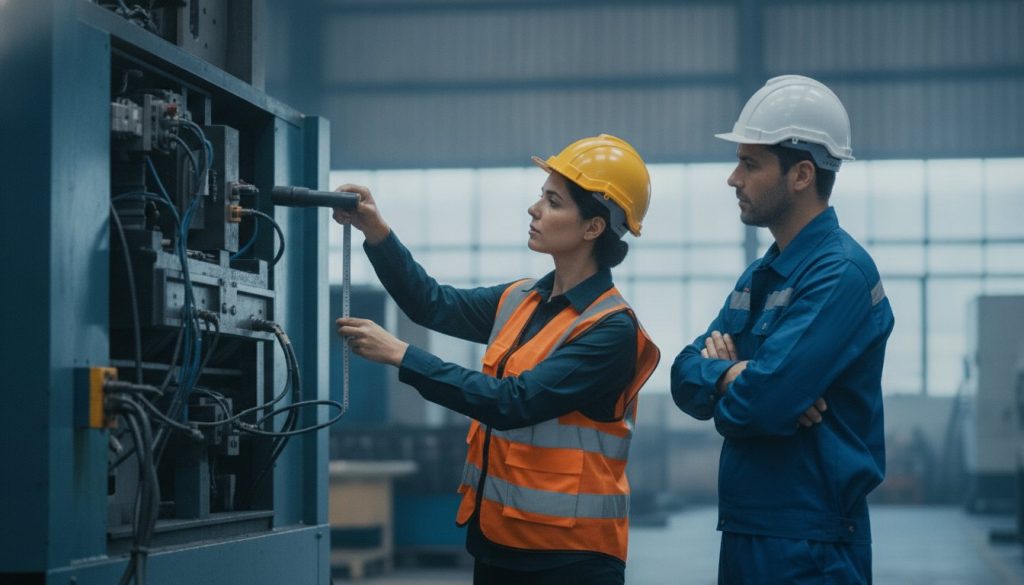
Typical tests for Annex IV machinery
| Machinery | Typical tests |
|---|---|
| Presses and press brakes | Stopping time and overrun measurement, safety distance of light curtains and two-hand controls, single-stroke and anti-repeat functions, validation of the press safety control, hydraulic restraint and load-holding functions |
| Vehicle servicing lifts | Static and dynamic overload tests, mechanical locking and catching devices, synchronisation of the carrying elements, lowering speed, behaviour on hose or pipe failure, safety distances to the floor |
| Machinery for lifting persons | Static and dynamic stability tests, overload tests, load-sensing and moment-sensing systems, emergency lowering, tilt alarm, structural verification and functional tests of all safety devices |
| Woodworking machinery and saws | Run-down (braking) time of the tool, guard coverage and adjustment, riving knife and anti-kickback devices, tool retention, dust extraction connection and noise emission |
| Moulding machinery | Interlocking of the mould area guards with independent monitoring, power-operated guard closing forces, protection against hot surfaces and ejected material |
| ROPS and FOPS | Lateral, vertical and longitudinal loading and energy absorption tests, drop tests and verification of the deflection-limiting volume (DLV) |
On-Site (Field) Machinery Safety Tests
Many machines are too large, too heavy or too integrated into a production line to be transported to a laboratory. In these cases TESTPLUS technical experts perform the machinery safety test on site, at the manufacturer’s factory or at the place of installation, using calibrated portable measuring equipment. On-site testing typically includes:
- Electrical safety measurements in accordance with EN 60204-1
- Stopping time measurement and safety distance verification
- Functional testing and fault simulation of safety functions
- Load, overload and stability tests with certified test weights
- Noise emission measurements under defined operating conditions
- Inspection of guards, safety distances, markings and instructions
To allow the tests to be completed in a single visit, the manufacturer provides the machine in its final configuration, a suitable test area, the power supply, test loads, an operator familiar with the machine, and the technical documentation (risk assessment, electrical, hydraulic and pneumatic diagrams, safety function list and calculations).
The Machinery Safety Test Process
- Application: the manufacturer submits the machine description, intended use and technical data.
- Determination of scope: applicable directives, Annex IV status, standards and the test plan are defined.
- Technical file review: risk assessment, drawings, diagrams, calculations and instructions are examined.
- Testing: tests are carried out in the laboratory or on site in accordance with the test plan.
- Reporting: results, measurement values and any nonconformities are documented in the test report.
- Certification decision: where the requirements are met, the EC type-examination certificate or the relevant certificate of conformity is issued.
As a conformity assessment body, TESTPLUS acts independently and impartially: it tests and assesses the machine, while design solutions and the preparation of the technical file remain the responsibility of the manufacturer. See also our machinery certification process.
Machinery Regulation (EU) 2023/1230: What Changes for Testing?
The Machinery Regulation (EU) 2023/1230 replaces Directive 2006/42/EC and applies from 20 January 2027. The main points affecting machinery safety tests are:
- The Annex IV list becomes Annex I, divided into Part A (notified body involvement always required) and Part B (internal production control possible when harmonised standards or common specifications are fully applied).
- Safety components and machinery with self-evolving behaviour based on machine learning that ensure safety functions are added to the high-risk list.
- New essential requirements address protection against corruption (cybersecurity of safety-related control systems), autonomous mobile machinery and human-machine interaction.
- Digital instructions for use are permitted under defined conditions.
Read more in the new Machinery Regulation 2023/1230.
Frequently Asked Questions
Is a machinery safety test mandatory for every machine?
The Directive requires every manufacturer to carry out the necessary research and tests to verify that the machine can be assembled and put into service safely. For machinery outside Annex IV this can be done under the manufacturer’s own responsibility; many manufacturers nevertheless request an independent test report to support their technical file.
Which standard applies to my machine?
First check whether a type C standard exists for the machine. If it does, it defines the main test programme, supported by the type B standards it refers to. If no type C standard exists, the tests are derived from EN ISO 12100 and the relevant type B standards.
Can the tests be performed at our factory?
Yes. Most machinery safety tests can be performed on site, provided the machine is in its final configuration and the test conditions described above are available.
How long does a machinery safety test take?
The duration depends on the machine type, the number of safety functions and the completeness of the technical file. On-site testing of a single machine is usually completed within one to three working days, followed by the reporting stage.
Does the machine also need EMC and noise assessment?
Machines with electrical or electronic equipment fall under the EMC Directive 2014/30/EU, and equipment for use outdoors may fall under the Outdoor Noise Directive 2000/14/EC. TESTPLUS is one of only seven bodies worldwide notified under all three directives, so the machinery, noise and EMC conformity assessments can be planned together.
These tests form the technical basis of CE testing of machinery. As a CE certification body for machinery, TESTPLUS (NB 2908) uses the results for EC type-examination and voluntary machinery CE certification.
Request a Machinery Safety Test
Send us the machine type, model, technical data and intended use. We will prepare a test plan and quotation for your machine.
