
The European Commission’s guide to the Machinery Regulation (EU) 2023/1230 is starting to take shape. The first four draft chapters, dated 18 October 2026, were made public on 19 October 2026. They cover protection against corruption, seating and restraint systems, vibrations, and contact with live overhead power lines.
The Regulation applies from 20 January 2027, so these chapters are an early indication of how several new or revised requirements in Annex III are likely to be read. This article summarises what the drafts say, explains their status and lists the points manufacturers can review now. For the wider picture, see our overview of the new Machinery Regulation.
Status of the Draft Chapters
- Not legally binding: at the Expert Group on Machinery meeting of April 2026, the Commission confirmed that the guide is supportive and non-binding. The legal text of the Regulation prevails.
- Not yet final: the Editorial Group’s report of 22 October 2026 lists all four chapters as approved by the Editorial Group and awaiting endorsement by the Expert Group. The wording may still change.
- Not yet the whole guide: other chapters are still being worked on. The complete guide has been reported for the fourth quarter of 2026, but no publication date has been announced.
The Four Topics at a Glance
| Topic | Annex III section | Main point in the draft |
|---|---|---|
| Protection against corruption | 1.1.9, 1.2.1(a) and (f) | Events in the tracing log are stored for at least five years after a change in the safety software |
| Seating and restraint systems | 3.2.2 | Preventing travel when the restraint is not used is treated as a safety function |
| Vibrations | 1.5.9, 2.2.1.1, 3.6.3.1 | Design at source comes first; declared values and their uncertainty remain required |
| Overhead power lines | 3.5.4 | Recommended where the maximum height of the machine exceeds 4 metres above ground |
Protection Against Corruption and Tracing Logs
This chapter deals with sections 1.1.9 and 1.2.1(a) and (f) of Annex III, which concern protection against corruption and the safety and reliability of control systems. Its scope is deliberately narrow. The draft states that it does not cover the confidentiality of data or intellectual property, and that it gives no further general guidance on cybersecurity requirements or business continuity.
Under section 1.2.1(f), a tracing log of interventions and of safety software versions uploaded after the machine is placed on the market must be enabled for five years after such upload. The draft states that each specific event must be stored for at least five years after a change in the safety software, and that the log should be kept in a reliable storage location.
The draft also recalls Article 20(9): the presumption of conformity for sections 1.1.9 and 1.2.1 can apply where the machinery is covered by a cybersecurity certificate or statement of conformity issued under Regulation (EU) 2019/881. For practical questions, see our machinery cybersecurity checklist.
Seating and Restraint Systems
Section 3.2.2 applies to machinery with a significant risk of roll-over or tip-over. Where the restraint system is not used, it must not be possible for the machinery to move. A visual and audible signal at the driving position must alert the driver who is in that position without using the restraint. Restraint systems must not be fitted if they increase the risk.
The draft makes three points that affect design and documentation:
- “Significant risk” corresponds to “high risk” and “serious risk” in the manufacturer’s risk assessment.
- The function that prevents travel is to be considered a safety function, so it should be treated as part of the safety-related control system.
- Restraint systems placed on the market independently are safety components.
Vibrations
Section 1.5.9 requires risks from vibration to be reduced to the lowest level. The draft sets out the order of priority: design at source first, integrated protection second and information for the user third. Information in the instructions does not replace vibration reduction at the design stage.
The chapter also covers the values to be stated in the instructions:
| Section | Machinery | Information required |
|---|---|---|
| 2.2.1.1 | Hand-held and hand-guided machinery | Total value of continuous vibration, mean value of the peak amplitude of acceleration from repeated shock vibrations, and the uncertainty of both measurements |
| 3.6.3.1 | Mobile machinery | Whole-body weighted acceleration if it exceeds 0.5 m/s²; where it does not, this must be mentioned |
The draft refers by way of example to EN ISO 20643, EN ISO 1032, EN ISO 5349-3 and EN 12096 for measurement and declaration.
Contact With Live Overhead Power Lines
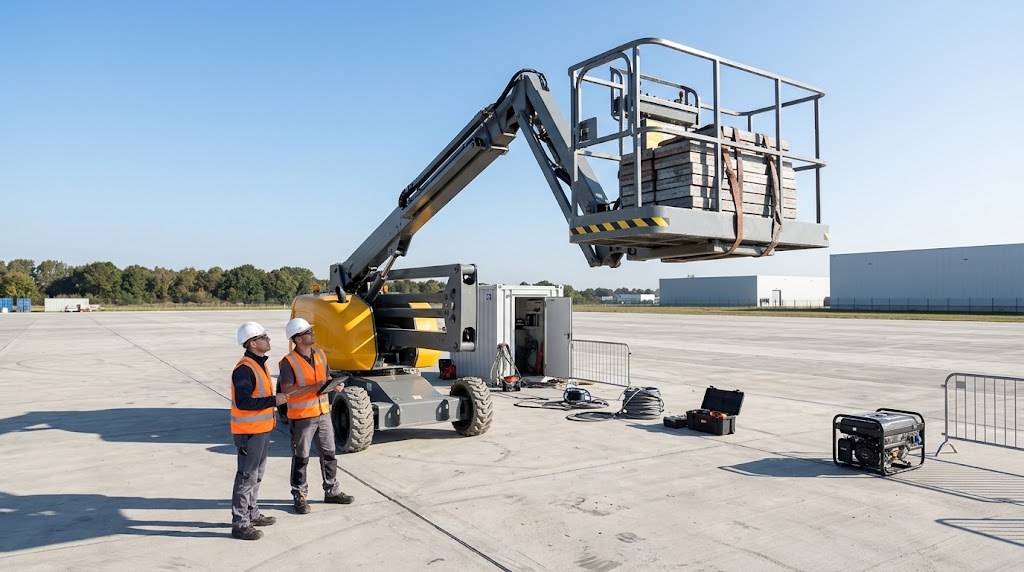
Section 3.5.4 says that, depending on their height, mobile machinery shall, where relevant, be designed, constructed and equipped against this risk. The legal text gives no height. The draft fills that gap with a recommendation: apply the requirement when the maximum height of the machine exceeds 4 metres above ground level.
That figure has clear limits. It is a recommendation in a non-binding guide and not a legal threshold. The draft says it applies without prejudice to national rules for users and to the manufacturer’s risk assessment, and that it is not relevant for machinery used on electrified railways. Height means the highest point a part of the machine can reach, including interchangeable equipment. Remote-controlled and autonomous mobile machinery are also concerned. Machines such as those covered in our lifting equipment article are an obvious case for review.
Chapters Still in Progress
According to the October 2026 Editorial Group report, the following subjects were not yet finished:
- Substantial modification, lifting, ergonomics and instructions, at various draft stages
- Self-evolving behaviour and control systems, where the combined draft was not agreed
- Digital documentation, where the combined draft was not agreed
- Autonomous mobile machinery, under review
What Manufacturers Can Review Now
- Check that software changes affecting safety functions leave a tracing log, and that the log can be kept for the required period.
- Review roll-over and tip-over in the risk assessment, and how the travel-prevention function is designed and validated.
- Compare the vibration information in the instructions with sections 2.2.1.1 and 3.6.3.1.
- For mobile machinery, record the maximum reachable height, including interchangeable equipment, and the reasoning on overhead lines in the risk assessment.
- Follow the final text. Decisions should rest on the Regulation itself, with the guide used as support once it is published.
Harmonised standards are moving on a parallel track. See our article on Decision (EU) 2026/2015 for the current position.
Frequently Asked Questions
Is the Machinery Regulation guide already published?
Not as a complete guide. Four draft chapters were made public on 19 October 2026. They were awaiting Expert Group endorsement according to the report of 22 October 2026.
Is the 4 metre value for overhead power lines mandatory?
No. The legal text refers to the height of the machinery without a figure. The 4 metre value is a recommendation in a draft, non-binding guide, and it does not replace the manufacturer’s risk assessment.
How long must the tracing log be kept?
Annex III section 1.2.1(f) refers to five years after the upload of the safety software. The draft states that each event must be stored for at least five years after a change in the safety software.
How TESTPLUS Can Help
TESTPLUS is EU Notified Body NB 2908 and one of only seven bodies worldwide notified for machinery, outdoor noise and EMC together. We carry out conformity assessment and do not provide consultancy. For the certification process, see our machinery CE certification page, or read our transition notice for certificate holders. You can also contact our team.
Our accreditation process with TÜRKAK and our designation process with the Ministry of Industry and Technology for the new Machinery Regulation (EU) 2023/1230 are ongoing.
Sources
- Regulation (EU) 2023/1230 – EUR-Lex
- Machinery – European Commission
- News on the guide for the Machinery Regulation, with links to the draft chapters – IBF Solutions
- Editorial Group report to the Expert Group, 22 October 2026 – IBF Solutions copy
