
TESTPLUS Teknik Kontrol ve Belgelendirme Ticaret Limited Şirketi
TÜRKAK AB-0155-U / AB-0181-YS
Notified Body NB 2908
TESTPLUS carries out product certification activities under Directive 2000/14/EC on noise emission in the environment by equipment for use outdoors in accordance with ISO/IEC 17065:2012 and ISO/IEC 17021-1:2015. This page provides clients and the public with a summary of the process, from application to the issue of the certificate and subsequent monitoring.
The programme covers product certification activities under Directive 2000/14/EC and the issue of certificates. At the application stage it is assessed whether the equipment falls under Article 12 of the Directive (equipment subject to noise limits; Article 5(a) of the Turkish implementing regulation) and whether the sound power level guaranteed by the manufacturer exceeds the permissible sound power level. Noise measurements are carried out on the basis of Annex III of the Directive and EN ISO 3744.
Before the first item of equipment is placed on the market or put into service, the manufacturer or its authorised representative submits a copy of the technical documentation to TESTPLUS. The technical documentation, the EC Declaration of Conformity, the CE marking and the indication of the guaranteed sound power level are examined; periodic checks and product checks at random intervals are carried out throughout production. If found compliant, a Technical File Control Certificate is issued.
Applied to individual items of equipment, each of which must be assessed separately. The technical documentation is examined, the unit is inspected to verify that it has been manufactured in accordance with the technical documentation, and the noise measurement is carried out. If found compliant, a Unit Verification Certificate is issued, valid only for the unit bearing the relevant serial/chassis number; this certificate is not subject to surveillance.
Note: Annex VII (unit verification) is within the scope of TESTPLUS’s TÜRKAK accreditation; the designation (notification) process as a notified body for this module is ongoing.
The manufacturer’s quality assurance system is assessed against Annex VIII; the assessment includes a visit to the manufacturer’s premises. It is carried out as Stage 1 (preliminary evaluation of documentation and site readiness) and Stage 2 (audit of the quality assurance system). If found compliant, a Full Quality Assurance Certificate is issued and the system is monitored through annual surveillance audits.
The noise certification process starts with an application. Applications are received using the FR14 application form: Application Form. Receipt of the application is acknowledged to the client in writing. At least the following information and documents are requested with the application:
The application may be refused in cases such as the product falling outside the Directive or outside TESTPLUS’s scope of authorisation and experience; the outcome is notified to the client together with the reasons.
If the application is found acceptable, a Product Certification Offer-Agreement is prepared for the noise certification process. Durations and fees are calculated according to TESTPLUS’s instruction for determining durations and fees. Assessment activities begin after the agreement has been signed by both parties.
Nonconformities are classified as minor or major and notified to the company in a Nonconformity Report; no certification decision is taken until nonconformities are closed. The company must send its action plan to TESTPLUS within 15 working days and close the nonconformities within 90 days. At the follow-up audit, an additional period of up to 60 working days may be granted for minor nonconformities. If the time limit is exceeded or the nonconformities cannot be closed, the process may be concluded negatively. In unit verification, no certificate is issued if the conformity criterion is not met.
In the noise certification process, the review and the certification decision are made by authorised TESTPLUS personnel who have not carried out the application review, technical assessment or audit for that file; the decision is not outsourced. In the case of a positive decision, the original certificate is sent to the client within 3 working days. A negative decision is notified in writing together with the reasons.
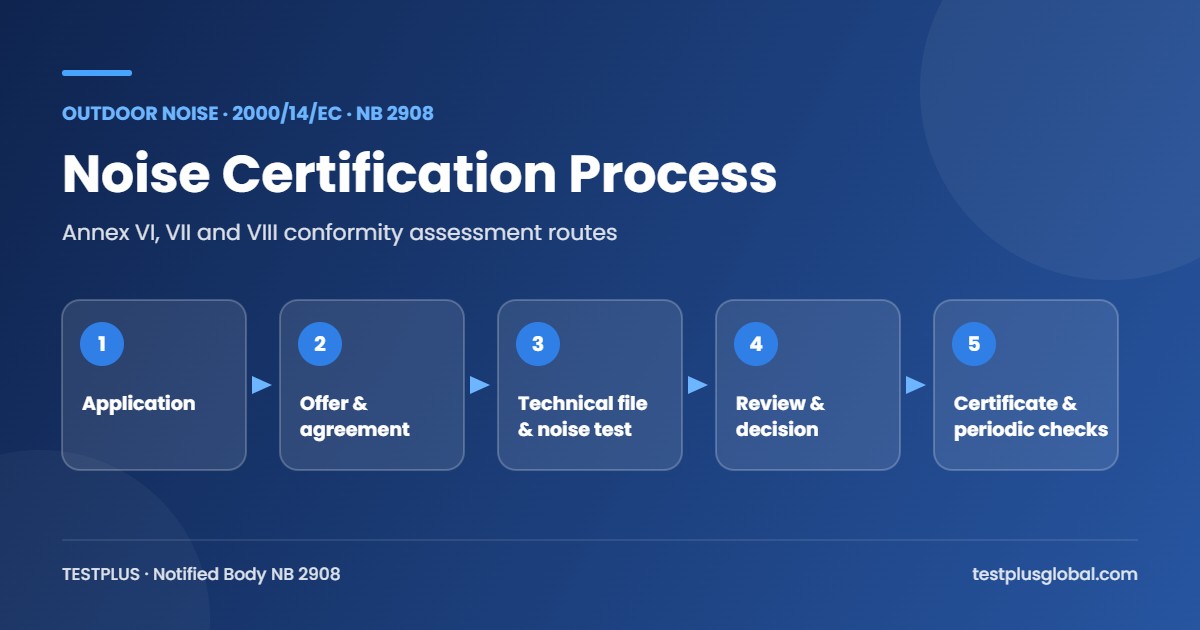
In short, the noise certification process at TESTPLUS moves from application and agreement through technical file review, noise measurement and independent review to the certification decision, followed by periodical checks or surveillance under the selected annex.
The certificate holder notifies TESTPLUS of changes to the application information, the product or its organisation within 30 days at the latest. Requests for certificate revision are evaluated; depending on the nature of the change, a limited-scope assessment or a new application may be required. Revision is not applied under Annex VII; a new application is made for the modified unit. For scope extension, the necessary certification activities are carried out for the products to be added. Models or variants that do not meet the requirements are removed from the scope; a reduction may also be requested by the client.
The certificate may be suspended in cases such as failure to maintain the certification requirements, failure to close nonconformities, misleading use of the certificate, refusal of a short-notice audit, failure to meet financial obligations, or at the client’s own request. The suspension period may not exceed 6 months; if the reasons for suspension are not resolved within that period, the certificate is withdrawn. The certificate may be withdrawn directly in cases such as false declarations, falsification of the certificate, or modification of the product without the written approval of TESTPLUS. The decision is notified to the client in writing, with reasons, within 5 working days.
During suspension the client may not exercise the rights arising from the certificate. On withdrawal, use of the certificate, the CE marking and all references to certification must cease immediately and the certificate must be returned. The status of certificates (active, suspended, withdrawn) is published at www.testplus.com.tr and notified to the relevant authorities.
For details: Certification Rules.
The client may appeal within one month against a decision taken by TESTPLUS concerning it; complaints and appeals are handled according to the procedure described on the Complaints and Appeals page.
The full text of the Outdoor Noise Directive 2000/14/EC is available on EUR-Lex.
TESTPLUS and its personnel keep confidential all information obtained during certification activities. This information is shared, unless prohibited by law, only with the bodies that accredit and designate TESTPLUS, at their request; it is shared with other third parties only by court order, and the client is informed. The certificate, technical file and related documents are kept for 15 years from the date of the certificate in environments where confidentiality is assured.
This page is the public summary of PR13 Noise Emission Product Certification Programme (2000/14/EC) Rev.16 (01.09.2026). The current full text of the document governs certification activities and is provided to interested parties on request. The Turkish original prevails in case of any discrepancy.

TESTPLUS Teknik Kontrol ve Belgelendirme Ticaret Limited Şirketi
TÜRKAK AB-0155-U / AB-0181-YS
Notified Body NB 2908
Abdurrahmangazi Mah.
Ebubekir Cad. No:34/15
Sancaktepe, İstanbul, Türkiye
Working Hours
Mon–Fri 09:00–18:00
Sat 10:00–17:00 (GMT+3)
Türkiye: +90 216 514 96 90
Türkiye (mobile): +90 535 101 06 06
London: +44 7760 682877
USA: +1 614 980 8975
info@testplus.com.tr
TESTPLUS Certification © 2007–2026 All Rights Reserved. | Privacy Notice | Cookie Policy |